Cairn is building for the future with sharper capabilities, deeper expertise and a leadership team poised to drive the next phase of growth.
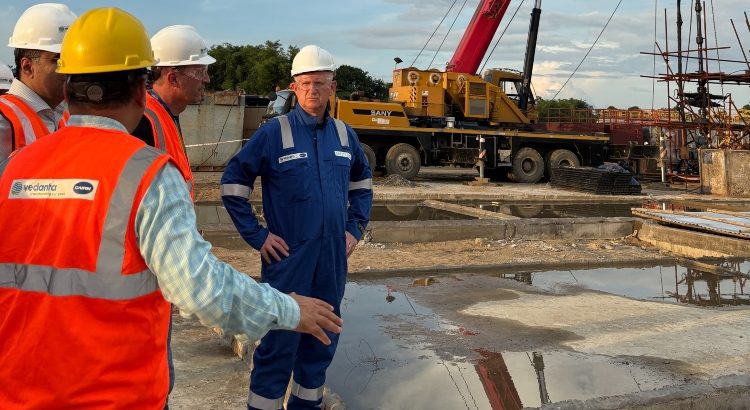
At the core of this journey is Graham Richardson, our Chief Development Officer who brings over 35 years of global experience. As Chief of Development and Subsurface, Graham envisions to unlock greater value from existing assets while reinforcing Cairn’s commitment to sustainable energy leadership.
We caught up with Graham for a candid Q&A to learn more about his journey and his vision for the road ahead.
Having been in the energy sector for over 35 years what excites you about your role at Cairn?
What excites me here at Cairn is the real variety of technical challenges. It’s a very diverse asset base. We’ve got an onshore field that’s relatively mature, where we’re working on enhanced oil recovery and tight oil development. These require rigorous technical planning but we also need to move fast. That makes it challenging but also exciting. We’re opening up new areas like the Northeast where we have exploration activity and deepwater developments in the East Coast that we hope will follow. What attracted me to this role was the diversity and the technical challenges across these assets. I believe there’s significant potential to grow but we must get the technical and commercial elements right.
How would you describe your job in one sentence?
I take discovered hydrocarbon molecules that are in the ground and not currently being produced and we design ways to bring those accumulations into production economically. My focus is on adding to the existing production Cairn is delivering today.
Across your career, which all geographies have you worked in?
Globally, I have worked in about six countries, India being the seventh country. Initially, I started in the UK North Sea and worked offshore in Thailand. Then I moved to a corporate head office in Geneva, Switzerland, followed by a stint in Russia. After that, I returned to the UK, then I worked in Abu Dhabi and most recently in Calgary, Canada, before joining Cairn. I have worked onshore and offshore, in conventional and unconventional fields. I hope this diversity of experience helps me make a difference here.


What’s the most complex development project you’ve worked on and how do those lessons apply here?
I have worked on mature field redevelopments and enhanced oil recovery projects. In aging fields, you have to be very precise because you’re spending money to access smaller or technically difficult pockets. These projects are challenging but add real value by extending field life. In Canada, I gained deep experience in tight oil and unconventional development over ten years. I’m now trying to apply those global best practices and learnings here. For instance, I have worked on similar redevelopment projects in the UK.
As someone who is leading development at Cairn, what’s one key lesson you want to pass on to your team or young leaders?
First, I strongly believe in teamwork and leveraging the diverse skills of the group. Development is a multidisciplinary effort involving geology, geophysics, reservoirs and projects, all must come together. Second, always keep an open mind. What worked in the past may not be the best solution going forward. And finally, a leader must set a clear course. Teams look to leaders for direction, so while it’s important to consider risks, it’s equally important to be decisive.
Cairn is known for its young, diverse talent, even in field roles, which is rare in the Indian oil and gas sector. What’s your view on this?
Yes, I have noticed this and it’s very encouraging. But developing young talent needs to be thoughtful and planned, it doesn’t just happen. We’re actively looking at how to deploy, mentor and train our young workforce in the best way. I have seen a lot of great potential in the organization. It just needs the right nurturing. Individual development is something I am passionate about and in the coming months, you’ll see more efforts from us in that direction.
What innovations or technologies do you believe will shape the future of the oil and gas industry?
There are two key aspects to this. While digital technology and AI are widely discussed and rightly so they only bring real value when applied to the right problems. From my petroleum engineering perspective, the true game changers for the next decade will be advanced recovery technologies enhanced oil recovery and innovations in drilling and completions all delivered in a cost-effective way. The oil that’s left in the world is increasingly difficult to extract, so efficiency and cost control are critical. The right technology at the right cost, that’s the key. As for AI and machine learning, I have already seen them being particularly effective in data mining and equipment performance monitoring especially in predicting equipment failures. Their ability to process vast amounts of data in real time is incredibly powerful. These are the most useful ways AI is helping today but we should keep looking for new ways it can support areas like subsurface work where we handle a huge amount of complicated data.
What’s one word your colleagues would use to describe you?
Accountable and positive.
How has your experience in India been so far from living and traveling to adapting to the culture, food and changes over the years?
I have visited India twice before on vacation, once about 20 years ago and again around 10 years ago but this is my first time spending an extended period here. The change since my earlier visits has been remarkable. I remember visiting Delhi nearly 18 years ago and the development especially in places like Gurgaon, has been tremendous. On those earlier trips, I explored Delhi, Agra, Goa and even took a short visit to Kerala while I was based in Abu Dhabi. Since moving here in February, I have tried to get out of the city once a month and have visited Jaipur, Jodhpur, Chandigarh, Rishikesh and Mathura so far. Each place has had something unique to offer. Rishikesh was fascinating with its spiritual atmosphere. I like to travel without expectations and just absorb places as they are. The most intense moment was definitely in Mathura, where I visited a Hindu temple in the old town. The narrow passage to reach the priest was so crowded that I was almost lifted off my feet by the crowd. As for Indian food, I’ve adjusted quite well. I actually lived in Thailand for three years where the food can be even spicier, so handling Indian spices hasn’t been a problem at all.


How do you unwind after a busy week?
My recent hobby is learning Hindi. I have learned a few words like Namaste and Kaise ho. I really want to get a teacher, but maybe once my family is here, we can learn together. Apart from that, I enjoy walking, mostly within my residential society here. I try to go for a walk first thing in the morning and again at night. It helps me stay energized. I also love visiting new places. When I have longer breaks, I enjoy heading to the mountains. Nature, mountains, lakes and rivers, they give me peace. When my family arrives, I hope we can visit the Himalayas. I have been to Nepal twice, once ten years ago and once when I was 25. I spent a whole month there.
Contributed by Wellverse Team